
If you’ve ever stared at a blank page wondering how to crank out quality content faster, AI content creation tools might be exactly what you’ve been missing.
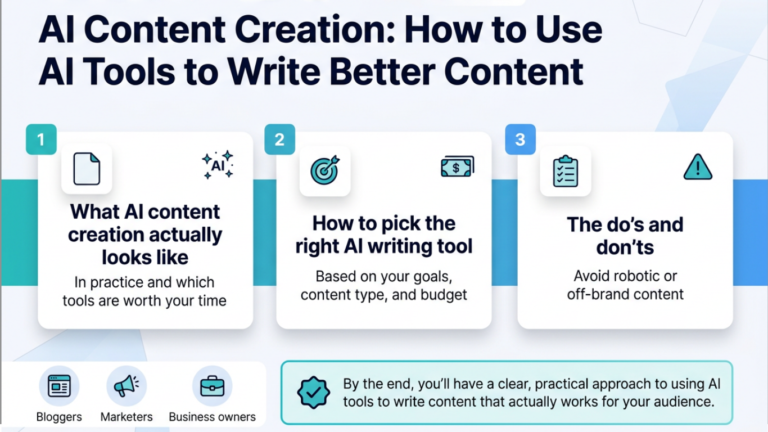
This guide is for bloggers, marketers, and business owners who want to create better content without burning hours every single time. You don’t need to be a tech expert — you just need to know how to use these tools the right way.
Here’s what we’ll cover:
- What AI content creation actually looks like in practice and which tools are worth your time
- How to pick the right AI writing tool based on your goals, content type, and budget
- The do’s and don’ts most people skip over — and why they end up with content that sounds robotic or off-brand
By the end, you’ll have a clear, practical approach to using AI tools to write content that actually works for you.
Understanding AI Content Creation Tools
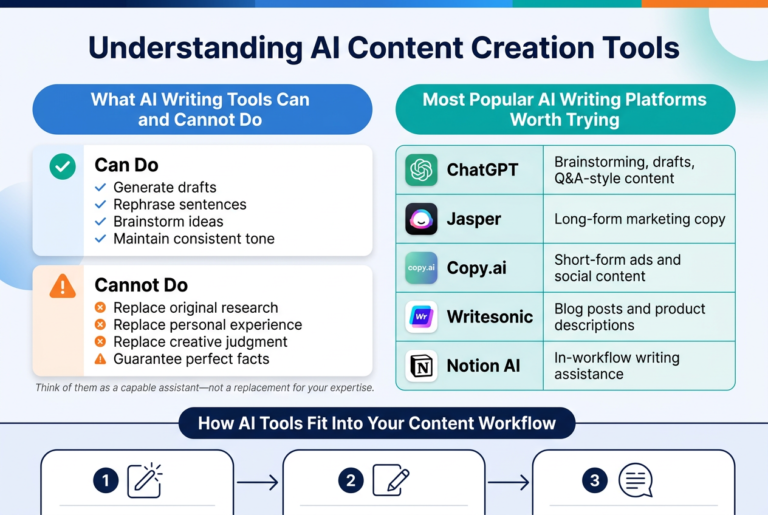
What AI Writing Tools Can and Cannot Do
AI writing tools are genuinely impressive at generating drafts, rephrasing sentences, brainstorming ideas, and maintaining consistent tone across long pieces. They save hours of staring at a blank page.
But they have real limits. They can’t replace original research, personal experience, or creative judgment. They sometimes get facts wrong, produce generic output, or miss nuance entirely. Think of them as a capable assistant—not a replacement for your expertise.
Most Popular AI Writing Platforms Worth Trying
|
Platform
|
Best For
|
|---|---|
|
ChatGPT
|
Brainstorming, drafts, Q&A-style content
|
|
Jasper
|
Long-form marketing copy
|
|
Copy.ai
|
Short-form ads and social content
|
|
Writesonic
|
Blog posts and product descriptions
|
|
Notion AI
|
In-workflow writing assistance
|
Each has its own strengths, so the “best” one depends on what you’re actually creating.
How AI Tools Fit Into Your Content Workflow
AI works best when it slots into an existing process rather than replacing it. A practical approach:
- Start with AI for outlines and rough drafts
- Edit manually to add voice, accuracy, and depth
- Use AI again for polishing, rephrasing, or headline variations
This keeps your content human-centered while cutting production time significantly.
Key Benefits of Using AI for Content Creation
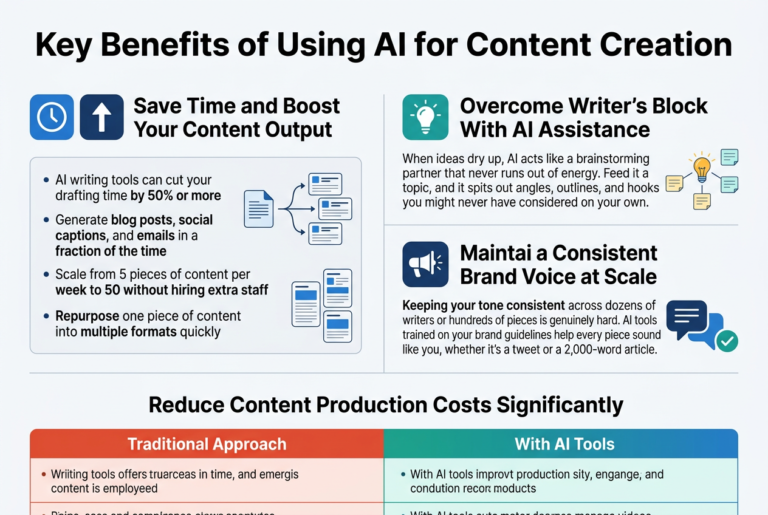
Save Time and Boost Your Content Output
AI writing tools can cut your drafting time by 50% or more. Instead of staring at a blank page, you get a solid first draft in minutes — freeing you to focus on editing, strategy, and creativity.
- Generate blog posts, social captions, and emails in a fraction of the time
- Scale from 5 pieces of content per week to 50 without hiring extra staff
- Repurpose one piece of content into multiple formats quickly
Overcome Writer's Block With AI Assistance
When ideas dry up, AI acts like a brainstorming partner that never runs out of energy. Feed it a topic, and it spits out angles, outlines, and hooks you might never have considered on your own.
Maintain a Consistent Brand Voice at Scale
Keeping your tone consistent across dozens of writers or hundreds of pieces is genuinely hard. AI tools trained on your brand guidelines help every piece sound like you, whether it’s a tweet or a 2,000-word article.
Do Ray-Ban Meta glasses work without a phone?
Reduce Content Production Costs Significantly
|
Traditional Approach
|
With AI Tools
|
|---|---|
|
Freelancer per article: $150–$500
|
AI-assisted draft: $5–$20
|
|
Weeks of production time
|
Hours
|
|
Inconsistent quality
|
Standardized baseline quality
|
The savings add up fast, especially for high-volume content teams.
How to Choose the Right AI Writing Tool for Your Needs
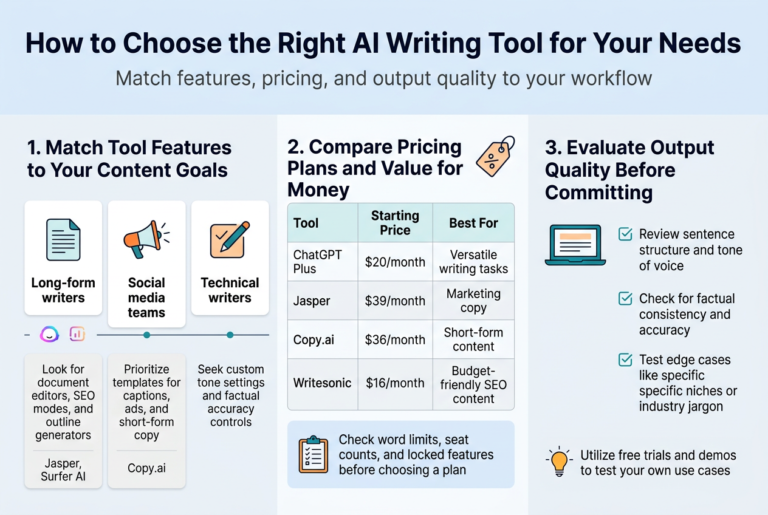
Match Tool Features to Your Content Goals
Before picking a tool, get clear on what you actually need it to do. A blogger writing weekly articles has
very different needs than a marketer producing hundreds of product descriptions.
Long-form writers → Look for tools with document editors, SEO modes, and outline generators (e.g.,
Jasper, Surfer AI)
Social media teams → Prioritize tools with templates for captions, ads, and short-form copy (e.g.,
Copy.ai)
Technical writers → Seek tools with custom tone settings and factual accuracy controls
Compare Pricing Plans and Value for Money
|
Tool
|
Starting Price
|
Best For
|
|---|---|---|
|
ChatGPT Plus
|
$20/month
|
Versatile writing tasks
|
|
Jasper
|
$39/month
|
Marketing Copy
|
|
Copy.ai
|
$36/month
|
Short-form content
|
|
Writesonic
|
$16/month
|
Budget-friendly SEO content
|
Always check word limits, seat counts, and what features are locked behind higher tiers.
Evaluate Output Quality Before Committing
Most tools offer free trials — actually use them. Test with your real content scenarios, not generic prompts. Check whether the output needs heavy editing, sounds robotic, or drifts off-topic. A cheaper tool that produces clean, on-brand copy beats an expensive one you constantly have to rewrite.
Best Practices for Writing Better Content With AI
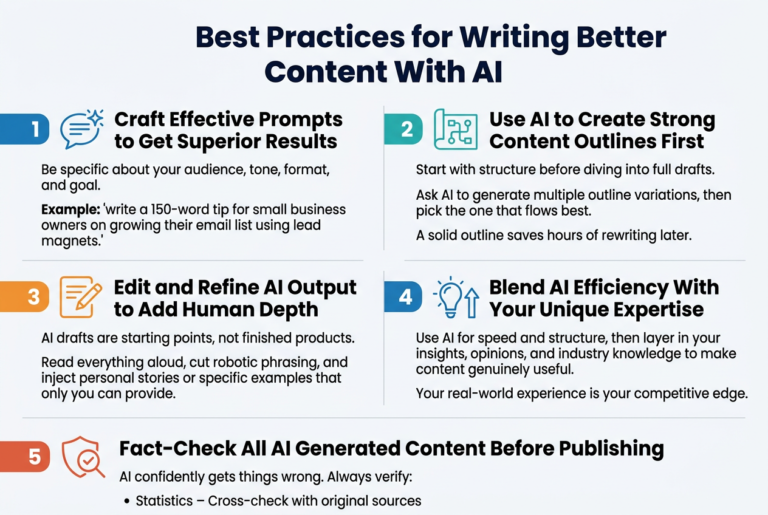
Craft Effective Prompts to Get Superior Results
Garbage in, garbage out. Give AI vague instructions and you’ll get vague content. Be specific about your audience, tone, format, and goal. Instead of “write about email marketing,” try “write a 150-word tip for small business owners on growing their email list using lead magnets.”
Use AI to Create Strong Content Outlines First
Start with structure before diving into full drafts. Ask AI to generate multiple outline variations, then pick the one that flows best. A solid outline saves hours of rewriting later.
Edit and Refine AI Output to Add Human Depth
AI drafts are starting points, not finished products. Read everything aloud, cut robotic phrasing, and inject personal stories or specific examples that only you can provide.
Blend AI Efficiency With Your Unique Expertise
Your real-world experience is your competitive edge. Use AI for speed and structure, then layer in your
insights, opinions, and industry knowledge to make content genuinely useful.
Fact-Check All AI Generated Content Before Publishing
AI confidently gets things wrong. Always verify:
Statistics – Cross-check with original sources
Quotes – Confirm attribution accuracy
Dates/names – Google before publishing
Trust but verify, every single time.
Types of Content You Can Improve Using AI Tools
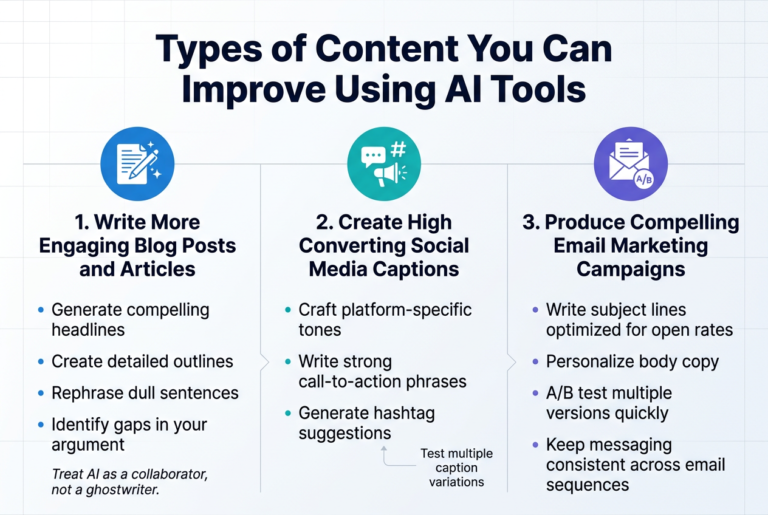
Write More Engaging Blog Posts and Articles
AI tools help you break through writer’s block and create well-structured posts faster. You can use them to:
- Generate compelling headlines that grab attention
- Create detailed outlines before diving into writing
- Rephrase dull sentences into punchy, readable content
- Identify gaps in your argument or topic coverage
The key is treating AI as a collaborator, not a ghostwriter. Your unique perspective still needs to shine through.
Create High Converting Social Media Captions
Social media captions live or die by their hook. AI tools can rapidly generate multiple caption variations so that you can test what resonates with your audience. They’re especially useful for:
- Crafting platform-specific tones (punchy for X, conversational for Instagram)
- Writing call-to-action phrases that drive clicks and engagement
- Generating hashtag suggestions relevant to your niche
Produce Compelling Email Marketing Campaigns
Email copy demands precision — every word either earns a click or loses a subscriber. AI helps you:
- Write subject lines optimized for open rates
- Personalize body copy for different audience segments
- A/B test multiple versions of the same campaign quickly
- Keep your messaging consistent across email sequences
Avoiding Common Mistakes When Using AI for Content
Prevent Generic Output by Giving Detailed Instructions
Vague prompts produce vague content. Instead of asking AI to “write about social media marketing,” specify your target audience, tone, key points and desired word count. The more context you provide,the more relevant and useful the output becomes.
Avoid Over-Reliance on AI Without Human Review
AI can miss nuance, get facts wrong, or misread your intent. Always have a human review the output before publishing. Think of AI as a capable first draft writer — not the final editor. Fact-check statistics,verify claims and refine the flow.
Stay Compliant With Search Engine Content Guidelines
Google’s helpful content guidelines prioritize original, people-first content. Purely AI-generated content that adds no real value can hurt your rankings. Make sure every piece:
- Serves a genuine reader need
- Includes original insights or expert perspective
- Avoids keyword stuffing or thin filler content
Protect Your Brand Voice From Sounding Robotic
AI defaults to a neutral, often bland tone. Combat this by:
- Training your AI tool with brand voice examples
- Rewriting sentences that feel stiff or overly formal
- Injecting personality, humor, or storytelling where appropriate
Your audience connects with humans — make sure your content still sounds like one.
Conclusion
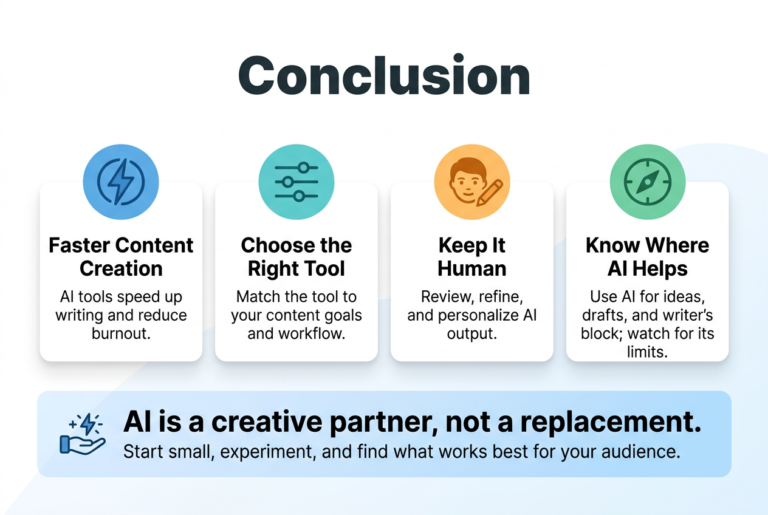
AI tools have genuinely changed the way content gets created, making it faster and easier to produce quality writing without burning out. From picking the right tool for your specific needs to following best practices that keep your content sounding human, the approach you take really does matter. Knowing what types of content AI can improve — and where it sometimes falls short — helps you get the most out of these tools without running into the usual pitfalls.
The key is treating AI as a creative partner, not a replacement for your own voice and judgment. Use it to speed up your workflow, beat writer’s block, and sharpen your ideas, but always review and personalize what it produces. Start small, experiment with different tools, and pay attention to what works best for your audience. Once you find your rhythm, you’ll wonder how you ever managed without it.
Suggested Blogs:- Midjourney Review: Still the King of AI Art in 2026?