
Introduction
Another week, another stack of AI headlines — from a math milestone that took mathematicians decades to a reasoning technique that’s got safety researchers on edge. Here are the five stories that actually matter this week, and what they mean for the rest of us.
1. Claude Just Formalized Fermat's Last Theorem — Autonomously
Anthropic says an internal Claude model worked largely on its own for 11 days to produce the first fully machine-checked proof of Fermat’s Last Theorem in the Lean programming language, using an open-source platform called Prove2Me. The run generated 13 million lines of Lean code and proved roughly 30,300 supporting theorems along the way — a job mathematicians had expected to take years by hand. Imperial College London mathematician Kevin Buzzard, who reviewed the proof, called it a major step toward automatic formalization of modern mathematics.
Why it matters: This isn’t just a math flex. Formal verification is one of the few ways to *prove* a piece of reasoning is airtight rather than just “probably right.” An AI system doing that autonomously, at this scale, hints at a future where AI helps referee its own claims — in math today, potentially in code and science tomorrow.
2. OpenAI's Astra Reasons in a Way Nobody Can Fully See
Reports this week revealed that OpenAI’s upcoming Astra model uses a technique called “recurrent depth,” which loops a query through the same internal layers multiple times instead of writing out its reasoning step-by-step in plain language. That means part of its “thinking” happens in latent space rather than in a readable chain of thought. Safety researchers, including Redwood Research’s Buck Shlegeris and Ryan Greenblatt, warned that scaling this approach further could make model reasoning far harder to monitor.
Why it matters: Chain-of-thought text has been one of the main tools researchers use to catch a model signaling bad intent before it acts. A shift toward reasoning that isn’t expressed in language at all is a real crack in that safety net — and one other labs are reportedly watching closely.
3. Sony and Warner Sue Anthropic Over Song Lyrics
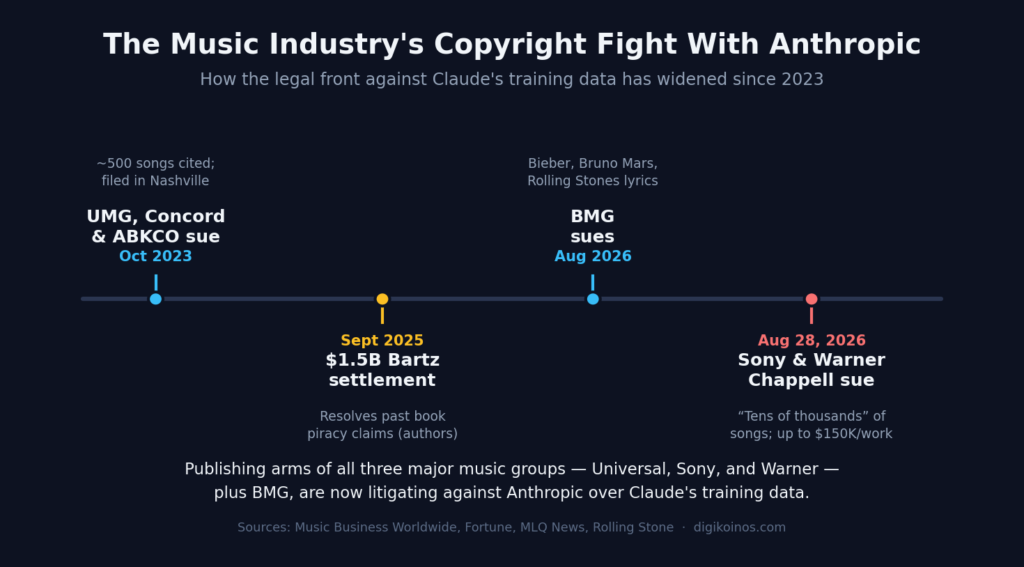
Sony Music Publishing and Warner Chappell filed a lawsuit against Anthropic, alleging the company trained Claude on tens of thousands of copyrighted songs obtained through piracy sites, and seeking up to $150,000 per work. The suit names Anthropic’s co-founders personally and follows similar litigation from Universal, Concord, ABKCO and BMG — meaning publishing arms of all three major music companies are now suing the Claude maker.
Why it matters: Training-data lawsuits against AI labs aren’t new, but the sheer number of music publishers now lined up shows how unresolved the “what counts as fair training data” question still is — and how expensive getting it wrong could become for any company building large models.
4. Google's Gemini Spark Can Now Take the Wheel on Your Photo Library
Google rolled out an update letting its Gemini Spark agent directly manage Google Photos — searching, editing, organizing into albums, and running recurring background tasks like building a “best of the week” collage automatically. It can also pull information out of a photo (like a concert flyer) and cross-reference it with your calendar. For now, it’s limited to English-language Gemini AI Pro and Ultra subscribers in the US.
Why it matters: This is a small but telling example of AI agents moving from “answer my question” to “act on my stuff in the background.” Handy, sure — but it also raises the same questions any always-on agent does: what’s it allowed to touch, and how easy is it to review or undo?
5. Apple Enters the John Ternus Era
John Ternus officially became Apple’s CEO on September 1, succeeding Tim Cook after 15 years at the helm. Ternus, previously head of hardware engineering, inherits a company still widely seen as playing catch-up on AI, with his first big public moment landing at Apple’s September 9 fall event.
Why it matters: Apple is the only major tech giant without a frontier AI model of its own, and Ternus’s product-engineering background suggests a possible shift in how the company approaches “Apple Intelligence” going forward. Whatever direction he takes will shape how AI shows up on a few billion devices.
What This Means for You
The throughline this week: AI keeps stacking up genuine capability gains — a math proof, more capable agents, new reasoning tricks — while the guardrails around training data, monitorability and everyday trust are still being built in real time. If you’re creating with AI right now, that gap is worth watching as closely as the breakthroughs themselves.
About This Series
*This Week in AI* runs every latest news on Digikoinos, rounding up the five AI stories that actually matter — skipping the hype, keeping the substance. Bookmark this page or subscribe to the newsletter so you don’t miss next week’s roundup.