
Editor's pick Digital World's AI Tools
Quick verdict
If you want the single best-looking AI-generated image with the least prompt-wrangling, Midjourney is still the tool most artists and designers reach for first in 2026. It isn’t the cheapest, it isn’t the easiest to learn, and it still doesn’t offer a free trial — but nothing else matches its aesthetic consistency straight out of the box.
What is Midjourney
Midjourney is an AI image generation tool that turns text prompts into artwork, running primarily through Discord and its own web interface. It has gone through multiple major model versions since its 2022 launch, with **Version 8.2** (released July 2026) as the current flagship — bringing sharper detail rendering, better multi-subject composition, and more reliable text-in-image output than earlier versions.
Unlike some competitors, Midjourney still has **no public API**, so it’s built for direct, hands-on use rather than being wired into other apps and workflows.
How it works
- Subscribe to a paid plan (there’s no free tier)
2. Generate through the Midjourney Discord bot using the `/imagine` command, or through the web app
3. Each prompt returns a set of four images
4. Upscale, vary, or edit your favorite result before downloading
The learning curve is real — getting consistently great results means learning Midjourney’s prompt syntax (aspect ratios, style weights, character consistency tags), not just typing a plain sentence.
Pricing breakdown
Midjourney runs on a subscription-only model with four tiers, priced by “fast GPU hours” rather than a flat image count — the more generation speed you need, the more you pay.
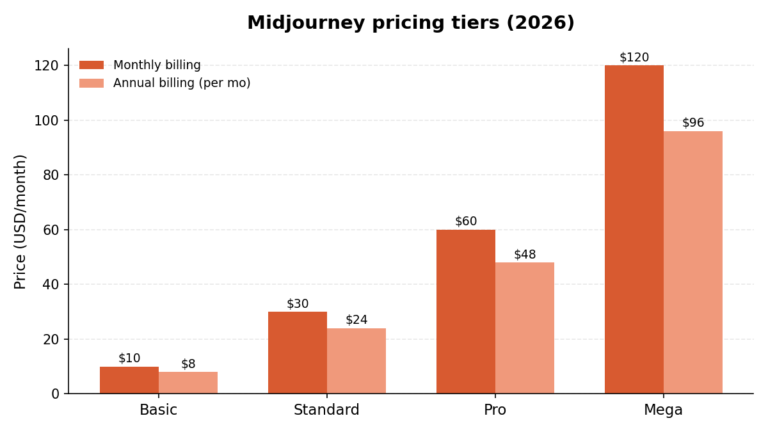
– Basic — $10/mo (~3.3 fast GPU hours), no Relax mode
– Standard — $30/mo, adds unlimited Relax mode (queued, slower generations)
– Pro — $60/mo, adds Stealth Mode (private generations) — required for most client work
– Mega — $120/mo, highest fast-hour allotment for studio-scale or heavy video use
Annual billing knocks 20% off every tier. All paid plans include general commercial usage rights, with one catch: businesses earning over $1M/year in revenue must be on the Pro or Mega plan to use Midjourney commercially.
Pros and cons
Pros
– Best-in-class aesthetic quality with minimal prompt effort
– Strong, active community for prompt-sharing and inspiration
– Frequent model updates (V8, V8.1, and V8.2 all shipped within months of each other in 2026)
– Full commercial usage rights on every paid plan
Cons
– No free trial — you’re paying before you know if it fits your workflow
– Discord-based workflow feels dated to newcomers, even with the web app maturing
– No API, so it can’t be automated into other tools the way some competitors can
– Real cost can run higher than the sticker price once you factor in extra GPU hours ($4/hour beyond your plan’s allotment)
Rating breakdown
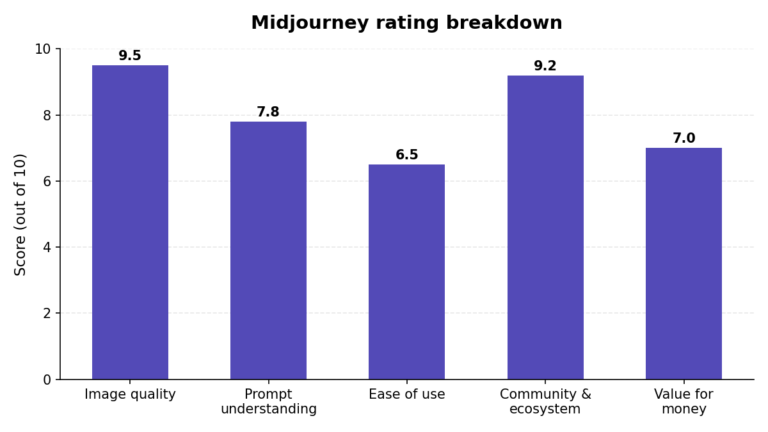
Overall score: 8.4 / 10
Image quality is where Midjourney separates itself from the pack — it’s the category that keeps most users subscribed despite the learning curve and the price.
Who it's for
Midjourney is the strongest fit for:
– Designers and illustrators who need polished visual output fast
– Marketers producing campaign or social visuals who can absorb a monthly subscription
– Anyone who values raw image quality over automation or API access
It’s a weaker fit if you need to embed image generation into an app or pipeline (no API), or if you want to test the waters for free before committing.
How it compares
We covered Midjourney alongside Stable Diffusion, Adobe Firefly, Canva AI, Leonardo AI, and Ideogram in our [Best AI Image Generators comparison](/best-ai-image-generators) — worth a read if you’re still deciding between tools rather than committing to Midjourney specifically.
FAQ
-Does Midjourney have a free trial?
No. Free trials were discontinued, so the cheapest way in is the $10/month Basic plan.
-Can I use Midjourney images commercially?
Yes, on every paid plan — with the exception that companies earning over $1M/year in revenue need the Pro or Mega tier.
-Does Midjourney have an API?
Not officially. Unofficial third-party wrappers exist but come with reliability and terms-of-service risk.