
Wearable tech used to mean one thing: a smartwatch on your wrist. Not anymore. In 2026, smart rings have quietly become one of the fastest-growing categories in wearable tech, with Oura, Samsung, RingConn, Ultrahuman, and Amazfit all fighting for finger space — offering the same round-the-clock health tracking as a smartwatch, minus the screen, the notifications, and the daily charging routine.
So which one should actually sit on your body all day? The honest answer is: it depends on what you want your wearable to *do* for you. Let’s break it down properly.
The Core Difference: Active Companion vs. Passive Observer
The clearest way to think about this comes from a recent comparison by AskVora, which frames it well: a smartwatch is an “active companion” — it shows real-time data, delivers notifications, tracks GPS routes, and lets you interact with apps right on your wrist. A smart ring, by contrast, is a “passive observer” — it quietly collects biometric data around the clock and hands it all over to your phone for review later.
Neither approach is “better” in the abstract. They’re built for different jobs.
Smart Ring vs Smartwatch: Where Each One Wins
| Feature | 💍 Smart Ring | ⌚ Smartwatch |
|---|---|---|
| Best at | Sleep tracking, 24/7 comfort, discretion | Real-time workouts, notifications, apps |
| Screen | None | Yes |
| Battery life | 6–14 days typical | 1–7 days typical |
| Sleep tracking accuracy | Excellent — finger arteries give cleaner signal | Good, but less consistent |
| Live workout data (pace, HR zones, GPS) | Limited or none | Full real-time display |
| Notifications / apps | None | Full smartphone-style access |
| Subscription | Sometimes required (e.g., Oura) | Rarely required |
| Comfort for 24/7 wear | Very high, feels like jewelry | Moderate — many people take it off at night |
| Starting price | Often cheaper hardware, but subscriptions add up | Wide range, one-time cost |
This lines up with what most 2026 reviewers are finding. Wareable’s testing notes that rings typically struggle with tracking workouts and rarely offer advanced features like ECG or blood pressure monitoring, and the lack of a screen makes them feel less practical day-to-day than a smartwatch.
On the flip side, for sleep specifically, rings tend to have the edge — a comparison from TheAITechPulse explains that rings pick up a cleaner optical heart-rate signal from the finger’s capillary beds, don’t have a glowing screen to disturb sleep, and last multiple nights without needing a charge.
Infographic: Lifestyle Fit Score
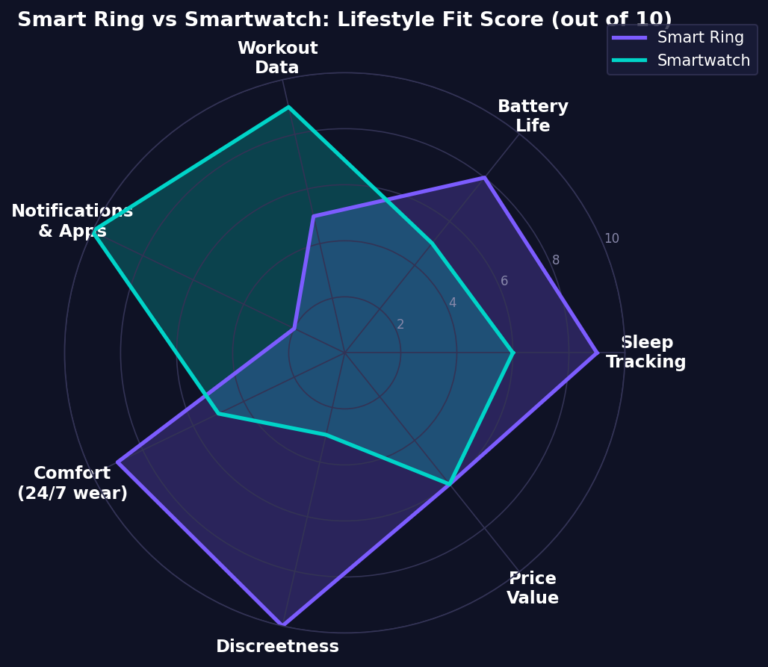
*This is a subjective scoring based on aggregated 2026 reviews — use it as a quick visual gut-check, not a lab result.*
Infographic: Battery Life, Side by Side
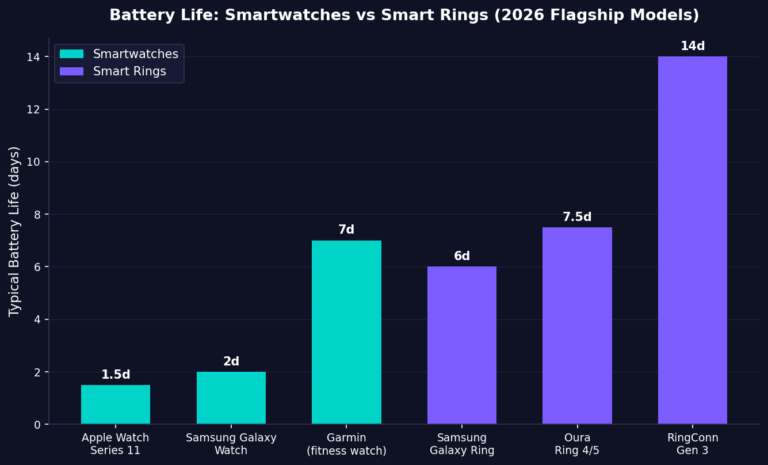
The gap here is real. Devices like the RingConn Gen 3 push past two weeks on a single charge thanks to efficient power management, according to WearableXP’s 2026 rankings, while most mainstream smartwatches still need a charge every one to two days if you’re using GPS and always-on display features regularly.
Smart Rings
– Oura Ring 5 — the category leader, with the deepest longitudinal sleep and readiness insights, but it requires a mandatory monthly subscription to unlock full data, as confirmed by Wareable.
– Samsung Galaxy Ring — no subscription needed, and integrates tightly with Samsung Health and Galaxy phones, per TechRadar’s testing.
– RingConn Gen 3 / Gen 2 Air — subscription-free, with some of the longest battery life in the category.
– Ultrahuman Ring Air / PRO — leans into metabolic health and circadian rhythm tracking, also subscription-free.
Smartwatches
– Apple Watch Series 11 — real-time heart rate zones, automatic workout detection, built-in GPS, and deep Apple Fitness+ integration, as detailed by AskVora.
– Samsung Galaxy Watch — the natural smartwatch counterpart to the Galaxy Ring, for people who want both notifications and a wrist-based screen.
– Garmin models — still the go-to for serious endurance athletes who need detailed live performance metrics.
So, Which One Actually Fits *Your* Lifestyle?
Pick a smart ring if you:
– Care most about sleep quality and recovery tracking
– Don’t want to think about your wearable — no notifications, no screen, no daily charging
– Already wear a watch you love and don’t want to give it up
– Want something that disappears into your routine (gym, shower, sleep — all without taking it off)
Pick a smartwatch if you:
– Train seriously and need live pace, heart-rate zones, or GPS mid-workout
– Want notifications, apps, and contactless payments on your wrist
– Prefer checking data in the moment rather than reviewing it later on your phone
– Don’t mind charging daily or every couple of days
Consider both if: you’re deep into optimizing your health data — a growing number of people are now wearing a ring for sleep and recovery *and* a watch for workouts, treating them as complementary rather than competing devices. Several 2026 comparisons, including Samsung’s own buying guide, frame the choice as coming down to personal preference and what you expect from your wearable tech rather than one device being objectively superior.
The Bottom Line
The smart ring vs. smartwatch debate isn’t really about which device is “winning” in 2026 — it’s about matching the device to the data you actually want. If your priority is understanding your sleep and recovery without another screen demanding your attention, a ring is very hard to beat. If you want a live dashboard on your wrist during workouts, plus notifications and apps throughout the day, the smartwatch still does that job better than anything else on the market.
The best wearable in 2026 isn’t the most talked-about one — it’s the one that matches how you actually want to interact with your own data.