
Every week brings a new headline. One day it’s a Fortune 500 company blaming AI for thousands of layoffs. The next, it’s a report claiming AI will create millions of new jobs. So which story is true?
The uncomfortable answer: both. The 2026 data shows a labor market splitting in two — one half shrinking fast, the other expanding just as fast, often inside the very same companies. Here’s what the numbers actually say, without the spin.
The Layoffs Are Real — and Accelerating
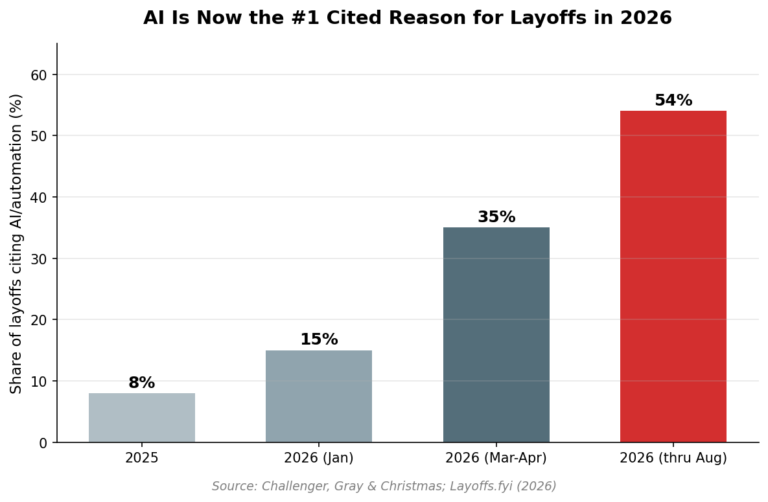
Start with the hard numbers. Through August 2026, AI-attributed layoffs in the United States hit roughly 205,000 workers — a figure that had already matched the *entire* 2025 total in under eight months. The cuts are concentrated in customer service, back-office data operations, entry-level software roles, and finance support functions — precisely the areas where generative AI tools have shown the fastest, most measurable productivity gains.
The shift in “tone” is just as telling as the scale. In 2025, AI was cited as a factor in fewer than 8% of layoff announcements tracked by Layoffs.fyi. By 2026, that share had jumped to 54%. Outplacement firm Challenger, Gray & Christmas reported that AI became the single most-cited reason for corporate job cuts in both March and April 2026 — the first time a technology factor has ever topped its monthly rankings.
Some of the highest-profile cuts:
– *Meta* cut roughly 8,000 roles even as it guided to $115–145 billion in AI infrastructure capex — a pattern repeated across Big Tech, where headcount budgets are being redirected toward GPU clusters and data centers rather than eliminated by AI doing the work directly.
– *Oracle* shed 21,000 roles over a 12-month stretch, explicitly naming AI adoption as a driver in its regulatory filings.
– *Dow* announced 4,500 cuts in a restructuring centered on AI and automation, showing the trend has moved well beyond software companies into chemicals, pharmaceuticals and manufacturing.
The group absorbing the sharpest hit is early-career workers. Stanford’s Digital Economy Lab, analyzing ADP payroll data across millions of U.S. workers, found that employment for 22–25 year-olds in AI-exposed occupations has fallen roughly 13% since late 2022 — a decline concentrated almost entirely in junior, task-based roles that large language models now handle competently.
Reviews , comparisons and buying guides for the latest phones
The Other Half of the Story: Job Creation Is Also Real
Here’s where the debate gets interesting — because the same year that produced record AI-linked layoffs also produced record AI-linked hiring.
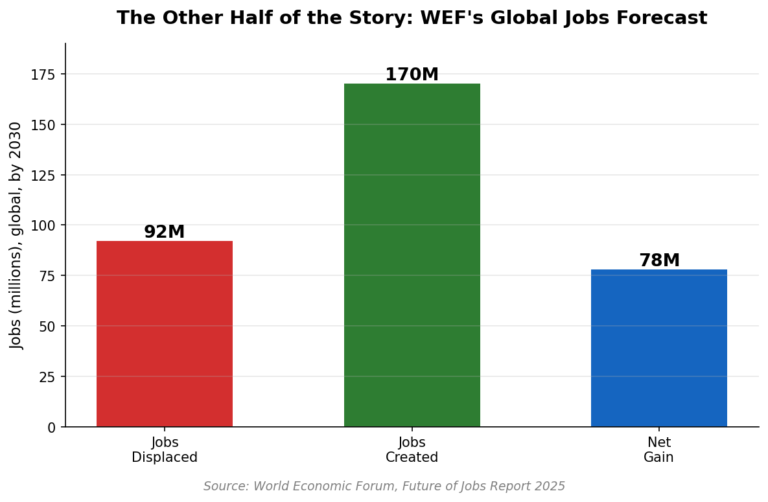
The World Economic Forum’s *Future of Jobs Report 2025* projects that AI and broader technological change will create 170 million new roles globally by 2030, while displacing 92 million — a **net gain of 78 million jobs** worldwide. Within the AI and data-processing category specifically, the Forum expects 11 million new roles created against 9 million displaced, a smaller but still positive net gain.
Reviews , comparisons and buying guides for the latest phones
The hiring data backing this up is already visible today, not just in 2030 projections:
– LinkedIn’s Economic Graph shows the global economy added “1.3 million AI-related jobs” since 2023, with “AI Engineer” ranked the #1 fastest-growing job on the platform for a second straight year — postings for that single title grew 143% year-over-year.
– The U.S. Bureau of Labor Statistics projects Data Scientist roles to grow 34% from 2024–2034, with roughly 23,400 annual openings, while Computer and Information Research Scientist roles are projected to grow about 20%.
– Workers who pair existing expertise with AI fluency are being paid a premium for it. PwC’s 2025–2026 Global AI Jobs Barometer found the AI-skill wage premium climbed to 56%, up from just 25% the year before — meaning employers aren’t just tolerating AI skills, they’re actively bidding for them.
Reviews , comparisons and buying guides for the latest phones
Same Technology, Opposite Effects Depending on the Role
The real story isn’t “AI is destroying jobs” or “AI is creating jobs” — it’s that AI is doing both simultaneously, sorted almost entirely by task type.
Reviews , comparisons and buying guides for the latest phones
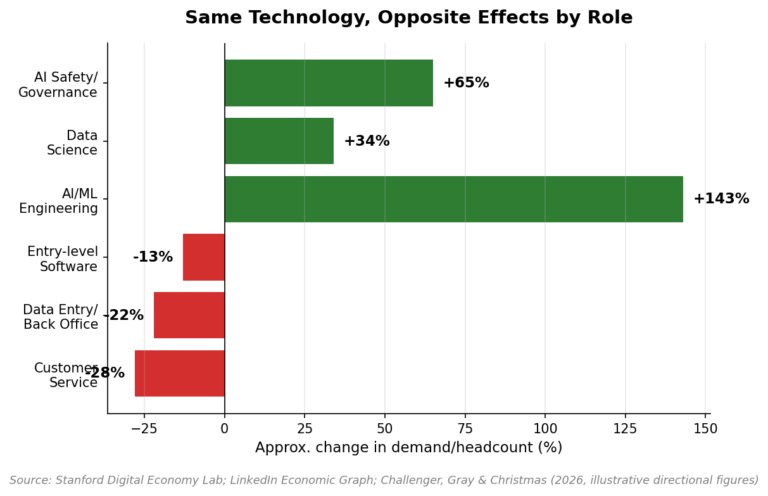
Roles built around routine, predictable, text-heavy tasks — customer support tickets, data entry, first-pass code review, basic compliance checks — are the ones shrinking. Roles built around building, directing, securing, or governing AI systems are the ones expanding, often within the same organizations doing the cutting. IBM, for example, has reportedly tripled its entry-level hiring even as it leans further into AI, arguing that human judgment is still required for a meaningful share of junior work — just a different share than before.
Goldman Sachs’ labor-market modeling captures this substitution-versus-augmentation split in a single monthly comparison: roughly 16,000 jobs a month are being lost to AI substitution, against roughly 9,000 a month being gained through AI augmentation — a net negative in raw headcount terms, even while entirely new job categories (AI ethics officers, synthetic data curators, AI-human collaboration specialists) are being invented from scratch.
Reviews , comparisons and buying guides for the latest phones
So Who’s Right — the Layoff Story or the Job Creation Story?
Both camps are cherry-picking a data set that’s genuinely real. The layoff numbers aren’t exaggerated, and neither are the job-creation projections — they’re just measuring different things on different timelines.
A few conclusions the data actually supports:
1. The pain is front-loaded and concentrated. Entry-level and routine-task roles are absorbing the layoffs *now*. The job creation numbers are real but skew toward specialized, technical, and often senior-leaning roles that take longer to fill and require different skills.
2. The net global number may end up positive, but “net positive” hides a brutal transition. A 78-million net gain by 2030 is not much comfort to someone laid off from a customer service job in 2026 who doesn’t have — and can’t quickly acquire — the skills for an AI governance role.
3. The wage gap is widening, not narrowing. A 56% pay premium for AI-skilled workers, compared to a wage floor collapsing for AI-exposed entry-level roles, is arguably the more important story than the raw job-count numbers on either side.
4. “AI did it” is becoming a convenient headline for company restructuring generally. Some of the layoffs framed as AI-driven — including Meta’s — are arguably capital reallocation toward AI infrastructure rather than AI directly automating the cut roles. That distinction matters for how much of the 2026 layoff wave is really about the technology versus about spending priorities.
Reviews , comparisons and buying guides for the latest phones
The Bottom Line
The AI jobs debate isn’t a contest with a winner. It’s a redistribution — away from routine, junior, and process-heavy work, and toward specialized, technical, and AI-fluent work, happening faster than most workers, or most companies’ retraining programs, can keep up with. The data doesn’t support “AI is a jobs apocalypse” or “AI job fears are overblown.” It supports something less quotable but more accurate: the labor market is being rewritten by function, not by headline.
What’s your take — is the net global job math (78 million net gain by 2030) reassuring, or does it understate how disruptive this transition will be for the people losing jobs today? Drop your thoughts in the comments.
Sources: Challenger, Gray & Christmas; Layoffs.fyi; Stanford Digital Economy Lab; World Economic Forum, *Future of Jobs Report 2025*; LinkedIn Economic Graph; U.S. Bureau of Labor Statistics; PwC 2025–2026 Global AI Jobs Barometer; Goldman Sachs Research
Reviews , comparisons and buying guides for the latest phones